
What Happens If Soil Is Too Compacted?
Last Updated: November 7, 2026
Quick Summary
What happens if soil is too compacted is that its particles are pressed together, shrinking the air and water spaces roots need. Water runs off instead of soaking in, roots stay shallow, and grass turns thin, patchy, and yellowish even with regular watering.
Compacted soil loses the pore space that holds air, water, and room for roots.
Water pools or runs off instead of soaking in, even after light rain.
Probe a screwdriver into the lawn: stopping at 3 to 6 inches signals moderate compaction.
Work or walk on soil only when it is moist, not soggy, to avoid squashing it.
Aerate the lawn, add compost, and overseed to repair compacted soil.
Table of Contents
How Compacted Soil Changes Its Structure
Knowing what happens if soil is too compacted starts with this: the particles get pushed together and the air and water spaces between them shrink. The result is usually a yard that struggles to grow no matter how often it gets mowed or watered.
Healthy soil has a crumbly structure with plenty of pore space. Those pores hold air, water, and room for roots. Compacted soil loses much of that space, so it becomes dense and hard, like packed clay in a brick.
Compacted soil is soil whose particles are pressed so tightly together that roots, water, and air cannot move through it easily.
Clay-heavy soil is especially prone to this. It already has tiny particles, and pressure makes them pack even tighter. Once that happens, rain and irrigation tend to sit on top instead of soaking in, which is one of the clearest answers to what happens if soil is too compacted.
What Causes Soil to Become Compacted
Compaction rarely happens on its own. It usually comes from weight or repeated pressure on the ground. The most common culprits are:
Heavy equipment, such as mowers, trucks, or trailers driven across the same spot
Foot traffic from kids, pets, or guests on the same path
Construction work that runs heavy machinery over bare soil
Working or walking on soil when it is wet, which makes it easier to squash
A common mistake is working the lawn when the soil is soggy. Wet soil compresses much more easily than dry soil, so a few passes can do lasting damage.
How to Tell If Soil Is Compacted
Most homeowners notice the signs before they test anything, but compaction is easy to confuse with drought, overwatering, poor nutrients, or disease. A structured diagnosis saves you from treating the wrong problem.
Start with the symptom pattern. Compaction has a signature that other problems do not:
Water pools or runs off instead of soaking in, even after light rain
Grass looks thin, patchy, or yellowish even with regular watering
The soil feels hard when you push a screwdriver into it
Weeds that tolerate hard ground, plantain, knotweed, crabgrass, take over bare spots
Damage is worst in traffic lanes, along fence lines, and near driveways or patios
Rule out the look-alikes. Drought causes browning too, but the soil is dry and crumbly rather than hard, and watering revives the lawn within a day or two. Overwatering causes yellowing and soggy soil, but the soil is soft and squishy, not dense. Nutrient deficiency yellows evenly across the lawn rather than concentrating in traffic areas. Disease usually shows distinct lesions, rings, or patches with defined edges. If the problem tracks foot traffic and water behavior rather than weather or fertilizer history, compaction is the likely cause.
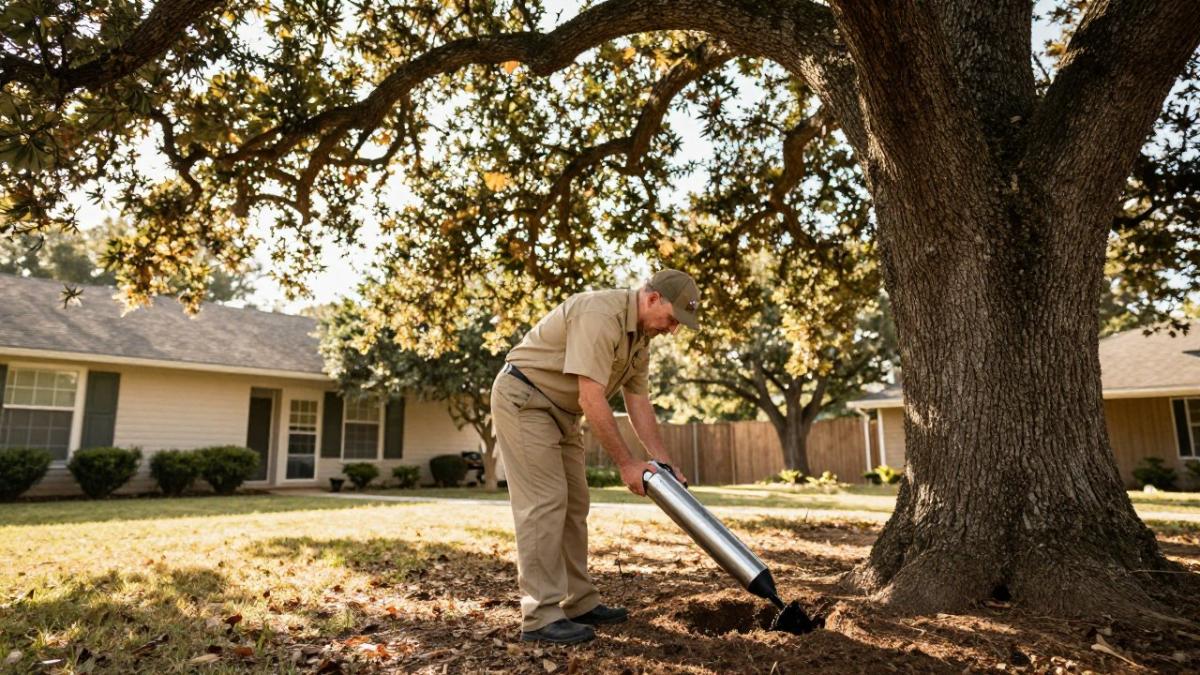
Do a simple field test. Push a long screwdriver or garden probe into the lawn. If it slides in easily in most spots but stops short in one area, that area is likely compacted. Repeat in several locations and note where resistance begins, the depth at which the probe stops tells you roughly how deep the compacted layer sits.
Assess severity. Resistance can be graded by depth:
Mild: probe enters 6 to 8 inches with moderate pressure; grass is thin only in traffic lanes
Moderate: probe stops at 3 to 6 inches; bare patches and runoff are visible
Severe: probe barely enters 1 to 3 inches; water stands for hours, roots are shallow, and weeds dominate
Know when a professional test is worth it. A soil penetrometer gives a more repeatable reading than a screwdriver, but readings vary with moisture, so test when soil is uniformly moist. Laboratory testing is most useful when you need to confirm a compacted layer deeper than a hand probe can reach, when a large area is affected, or when you are planning a renovation and need to know whether deep tillage or subsoiling is justified. For most home lawns, the screwdriver test plus the symptom pattern is enough to act on.
Watch out: testing right after a heavy rain can make even compacted soil feel soft, and testing in a drought can make healthy soil feel hard. Test when the soil is moist but not saturated for a reading you can trust.
Compaction has a recognizable pattern, and the screwdriver test gives a quick read on how deep it goes.
Severity | Probe depth | Visible signs |
Mild | 6 to 8 inches | Grass thin only in traffic lanes |
Moderate | 3 to 6 inches | Bare patches and runoff visible |
Severe | 1 to 3 inches | Water stands for hours, weeds dominate |
How Compaction Affects Roots, Water, and Air
Compaction does not just make soil hard. It collapses the pore network that roots, water, air, and soil life all depend on, and the damage compounds in a predictable order. Understanding that order is what separates a lawn that recovers from one that keeps declining. As pore space closes, the right response depends on the soil itself, and TLC Gardening connects that principle to the particular challenges of clay.
Step 1: Pore space collapses. Healthy soil is roughly half pore space by volume, split between larger macropores that drain quickly and smaller micropores that hold water for roots. Compaction squeezes the macropores shut first. Those are the channels that let water move down and air move in, so losing them is the single most damaging change.
Step 2: Water stops infiltrating. With macropores gone, water sits on the surface or runs off. Infiltration rate can drop dramatically, a common pattern is that a compacted lawn sheds most of a heavy rain instead of absorbing it. That runoff carries topsoil and nutrients with it, which is why compacted slopes erode and low spots flood.
Step 3: Roots hit a physical wall. Roots need pores at least as wide as the root tip to push through. In compacted soil they cannot penetrate, so they turn sideways and stay in the top few inches. Shallow roots dry out fast in summer heat and cannot reach deeper moisture, which is why compacted lawns brown off first during dry spells even when they are watered regularly.
Step 4: Oxygen runs short. Roots and soil microbes both consume oxygen. When air-filled pore space drops, oxygen levels fall and carbon dioxide builds up. Root growth can slow, and soil biology can shift toward organisms that break down organic matter less efficiently. The result is less nutrient cycling and a lawn that needs more fertilizer to look the same.
Step 5: Soil life declines. Earthworms, beneficial fungi, and bacteria all depend on pore space and oxygen. As compaction worsens, earthworm populations drop, fungal networks break up, and the soil loses the very organisms that would otherwise rebuild structure. This is why compaction tends to get worse without intervention rather than self-correcting.
Step 6: Plants decline and weeds move in. Shallow roots, poor water capture, low oxygen, and weakened soil biology combine into thin, patchy turf. Weeds that tolerate hard soil, plantain, knotweed, crabgrass in bare spots, colonize the gaps, and the lawn loses the competition.
Watch out: these effects do not stay in one spot. Water that runs off a compacted area often floods an adjacent low spot, compacting that area too, so a single problem zone can spread across a yard over a few seasons.
Symptoms That Get Worse Over Time
Compaction usually builds slowly, so the early signs are easy to miss. Here is how it tends to progress:
Early stage: Grass looks a little thin in high-traffic spots and water sits briefly after rain. Pore space is reduced but roots can still find channels.
Middle stage: Patches of bare soil appear, roots stay shallow, and the lawn turns brown faster in summer. Infiltration is visibly slower, and a screwdriver meets resistance.
Late stage: Runoff increases, weeds crowd out grass, and the area may stay soggy for days after rain because water cannot drain. Soil biology is measurably reduced, and recovery without intervention becomes unlikely.
Catching the problem at the early stage makes repair far easier, because the pore network and soil life are still intact enough to respond to aeration and organic matter.
How to Fix Compacted Soil in Your Lawn
Repairing a compacted lawn takes a few steps, done in the right order:

Aerate the soil. Use a core aerator to pull small plugs of soil from the lawn. Aerate when the soil is moist but not soggy.
Add organic matter. Spread a thin layer of compost over the lawn so it works down into the holes.
Overseed. Plant grass seed that suits your climate and sun exposure.
Water lightly and often. Keep the top layer moist while new roots establish.
Limit traffic. Keep equipment and foot traffic off the repaired area until the grass is well rooted.
How to Improve Compacted Soil Naturally
You can improve compacted soil without heavy machinery. Try these natural methods:
Mulch with leaves or wood chips to feed soil life
Plant deep-rooted perennials to slowly open up the ground
Use cover crops in garden beds during the off-season
Avoid tilling wet soil, which can make the problem worse
Earthworms are one of the best natural helpers. Their tunnels loosen soil and improve drainage. A healthy population is a good sign the soil is recovering.
How Long Compacted Soil Takes to Loosen and When to Call a Pro
Recovery is gradual. Expect several months to a year before a lawn looks fully healthy after aeration and overseeding. Natural methods like mulching and cover crops can take even longer, often one or two growing seasons.
Call a professional if:
The compaction covers a large area
Water still pools after you have aerated and added organic matter
Bare spots do not fill in after a full growing season
You are not sure what is causing the problem
Contact Perfect Green Landscapes for a FREE QUOTE on lawn repair.
BUTTON: Get Your Free Lawn Quote CARD_TITLE: Is your lawn struggling to grow? CARD_TEXT: Perfect Green Landscapes diagnoses compaction and restores North Dallas lawns.
Frequently Asked Questions
How can you tell if your lawn soil is compacted?
Push a screwdriver or a 6-inch garden trowel into the lawn. If it goes in with little effort, the soil is loose. If you struggle to push it past 2 to 3 inches, the soil is likely compacted. Also look for water pooling after rain, grass thinning in high-traffic paths, and runoff that flows instead of soaking in. Clay-heavy North Texas soil compacts easily, so these checks are worth doing each spring and fall.
Does compacted soil prevent grass roots from growing?
Yes. Compacted soil has less pore space, so roots struggle to push through it and cannot reach the oxygen and moisture they need. Grass roots often stay shallow in compacted areas, which makes the turf more vulnerable to drought and heat stress. Roots that do grow tend to spread sideways instead of downward, which limits how well the plant can draw water from deeper in the soil.
Can you loosen compacted soil without digging?
Yes, with core aeration. A core aerator pulls small plugs of soil out of the lawn, which opens channels for air, water, and roots without tearing up the surface. Topdressing with a thin layer of compost afterward helps fill those holes with organic matter. For small beds or tight spaces, a broadfork can loosen the soil by hand without turning it over.
Does gypsum help with compacted soil?
Gypsum can help in some situations, but it is not a cure for compaction. It works best on heavy clay soils with high sodium levels, where it helps particles clump and improves water movement. In most North Texas lawns, core aeration combined with compost does more to relieve compaction. A soil test will show whether gypsum is worth adding for your specific soil.


Comments